
Claremont Property, Cape Town: 6% Gross, 4.2% Net
Claremont apartments model 6% gross and 4.2% net at R30k-50k per sqm. Cavendish Square retail and the rail interchange make it the southern suburbs income play.
By Cape Town Invest Editorial · Updated September 7, 2026 · 12 min read
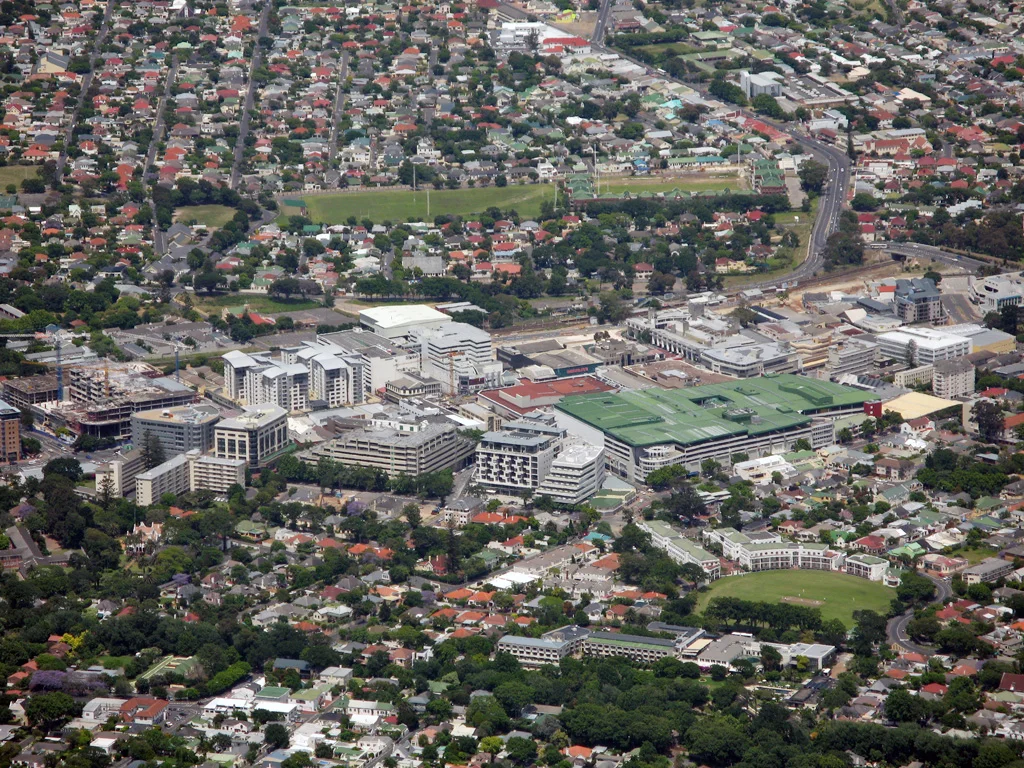
Quick answer: Claremont is the commercial and transport heart of Cape Town’s southern suburbs and one of the most convenient apartment-investor markets in the city, best read alongside the Southern Suburbs Cape Town property guide. An apartment models around 6% gross and 4.2% net, a stronger income profile than the family-home suburbs nearby, because a dense retail and office node meets a major transport hub and apartment-and-townhouse stock that lets cleanly to professionals. The case rests on Cavendish Square retail, the rail and bus interchange, and walkable convenience.
What do the 2025 to 2026 numbers say about Claremont?
Anchor any Claremont thesis in the data before you evaluate a single listing. The table below frames the suburb’s income, price, and demand profile against the wider city: a modelled 6% gross and 4.2% net on apartment stock, built-area pricing around R30,000 to R50,000 per square metre, and a 15 minute drive to the City Bowl. Read it as the baseline you test each individual listing against, not as a valuation.
| Metric | Figure | What it signals |
|---|---|---|
| Apartment gross yield (modelled) | ~6% | Stronger income than family-home suburbs |
| Apartment net yield (modelled) | ~4.2% | An income-led hold |
| Built-area price per square metre | ~R30,000 to R50,000 | In line with Newlands, far below the Atlantic Seaboard |
| Drive to City Bowl | ~15 minutes | Close to the urban core |
| Drive to Cape Town airport | ~20 minutes | Practical for working tenants |
| Major transport hub | Rail and bus interchange | Core driver of professional demand |
| Cavendish Square retail | Anchor shopping and office node | Sustains footfall and employment |
| Dominant stock type | Apartments and townhouses | Higher-yield, lower-entry profile |
| Foreign buyer surcharge | None | Versus UK 2% and Singapore 60% |
| Body corporate levies | Apply to sectional title | Must be modelled into net yield |
The headline pairing is the modelled 6% gross and 4.2% net on an apartment let. That roughly 1.8 percentage point spread between gross and net reflects municipal rates, body corporate levies on sectional title units, maintenance, letting commission, and insurance. Levies are the line investors most often forget in Claremont because so much of the stock is sectional title, so always pull the body corporate schedule and reserve fund before you model net. Even after that, the suburb lands above the family-home yields nearby, which is why Claremont reads as the income end of the southern suburbs.
The demand signals tell the other half of the story. Cavendish Square retail, the dense office and medical employment around it, and the rail and bus transport hub keep a professional tenant pool competing for apartments and townhouses all year. That competition supports both rental income and capital values, which is why Claremont is one of the more liquid apartment markets in the southern suburbs. For the full yield methodology by suburb and home type, see the Cape Town Rental Yield Guide.
Why is Claremont an income-led apartment play?
Three things put Claremont at the income end of the southern suburbs. First, tenant depth. The rail and bus interchange, the office and medical cluster around Cavendish Square, and the professional overflow from the university corridor keep apartments competing for tenants through the year rather than in a summer season, which is what holds vacancy down and supports the modelled 6% gross.
Second, lower entry price per unit. Much of Claremont’s stock is sectional title apartments and townhouses, so the purchase price per unit stays well below the freehold family homes of Rondebosch, Newlands, and Constantia. A sensible entry price against firm professional rents lifts gross toward 6%, where the family-home suburbs compress it toward 5.5% and prestige Constantia toward the high 2% net range.
Third, employment depth. Claremont is not just a place to shop; it is a major southern-suburbs employment node, with offices, medical facilities, and retail concentrated around Cavendish Square. That on-the-doorstep employment gives the rental market a self-reinforcing tenant base. For how Claremont sits beside its family-home neighbours, see Rondebosch and Newlands.
What are the pros and cons of investing in Claremont?
| Pros | Cons |
|---|---|
| Higher modelled yield near 4.2% net than family suburbs | Body corporate levies reduce net on sectional title |
| Dense professional tenant demand and low vacancy | Less green space than Newlands or Constantia |
| Cavendish Square retail and employment node | Traffic and congestion around the hub |
| Major rail and bus transport hub on the doorstep | Apartment supply can cap rental growth in pockets |
| Lower entry price on apartments and townhouses | Smaller capital-growth story than prestige homes |
| No foreign buyer surcharge for non-residents | Non-residents face tighter loan-to-value limits |
Cavendish square retail and the transport hub
Claremont is built around Cavendish Square, and that single node explains much of the suburb’s investment appeal. Cavendish Square anchors a dense cluster of shops, restaurants, offices, and medical facilities that draws daily footfall from across the southern suburbs, which sustains both employment and the kind of walkable lifestyle that professional tenants pay for. An apartment within walking distance of that node lets quickly because tenants can live, work, and shop without depending on a car, a genuine advantage in a city where transport costs and traffic shape where people choose to rent.
Layered on top is the transport hub. Claremont sits on a major rail and bus interchange roughly 15 minutes from the City Bowl, which extends its tenant catchment well beyond people who work in the suburb itself. Commuters who work in the city centre or elsewhere on the rail line can base themselves in Claremont for the convenience and the retail, which deepens the rental pool and keeps vacancy low. For an investor, the practical takeaway is that proximity to both Cavendish Square and the transport interchange is the value driver to underwrite, so prioritise units that are genuinely walkable to both.
Apartments, townhouses, and investor convenience
Claremont is dominated by apartments and townhouses, and that stock profile is exactly what makes it an income-led market. Sectional title units carry a lower entry price than freehold family homes, let cleanly to single professionals and couples, and concentrate maintenance responsibility in the body corporate, which suits a hands-off or offshore investor who wants convenience as much as the tenant does. A well-located one or two-bedroom apartment near Cavendish Square is one of the more liquid investment products in the southern suburbs, both to let and to resell.
The convenience that attracts tenants also attracts investors, but it comes with a discipline: levies. Because most Claremont stock is sectional title, the body corporate levy and the building’s reserve fund are central to net yield, not an afterthought. A unit advertising 6% gross can fall toward 4.2% net once levies, rates, maintenance, letting commission, and insurance are modelled, and a building with a weak reserve fund can hit owners with special levies on top. Always pull the levy schedule, the latest financials, and the reserve fund position before you offer. For the city-centre apartment comparison that many Claremont investors weigh against this suburb, see the City Bowl guide.
How do foreign buyers approach Claremont?
The two practical considerations are sectional title and financing. Because most Claremont stock is sectional title, a foreign buyer must check body corporate levies, rules, and the reserve fund before committing, since those costs sit directly inside the net yield. On financing, non-residents typically face tighter loan-to-value limits from South African banks, often financing around half the purchase price locally and bringing the balance from offshore, and that offshore capital must be recorded correctly at entry so capital and future gains repatriate cleanly at exit.
What risks should you plan for with Claremont?
Claremont is liquid and transparent, but the suburb has specific risks worth modeling before any Offer to Purchase. The table below maps the main ones against a mitigation.
| Risk | Why it matters | Mitigation |
|---|---|---|
| Underestimating body corporate levies | Levies cut gross to net on sectional title | Pull the levy schedule and reserve fund |
| Weak reserve fund | Triggers special levies on owners | Review the latest body corporate financials |
| Apartment oversupply in pockets | Caps rental growth on generic units | Favour walkable, well-located stock |
| Yield expectations too high | Apartment let lands near 4.2% net, not 7% | Model on net, including levies |
| Traffic and congestion near the hub | Affects desirability of certain blocks | Inspect access, parking, and noise |
| Offshore funds not recorded | Repatriation problems for foreigners at exit | Record capital at entry with a conveyancer |
The single most common error is buying on a headline gross yield and ignoring the body corporate levy, which is precisely the line that turns a 6% gross apartment into a 4.2% net one in Claremont. The second error is assuming all apartment stock is equal; a generic block away from Cavendish Square and the transport hub can sit empty while a walkable, well-located unit lets immediately, so location within the suburb matters as much as the suburb itself. Always review the body corporate financials and reserve fund before you commit.
Insider tip: read the reserve fund before you read the rental appraisal. In Claremont the gap between a 6% gross and a 4.2% net apartment is almost entirely the body corporate levy, and the levy you inherit is decided by a reserve fund most buyers never open. Cape Town Invest asks for three documents before any offer on a Claremont sectional title unit: the current levy schedule, two years of body corporate financials, and the most recent AGM minutes. A scheme with a thin reserve in a building over thirty years old will eventually special-levy for lifts, roofs or plumbing, and one special levy can erase a full year of net income on a R2.5m unit. Blocks within a short walk of Cavendish Square and the rail interchange also re-let faster after a vacancy, so walkability inside the suburb protects both the rent roll and the exit price.
Which Claremont property fits your investment goal?
Claremont fits income-led apartment and convenience-driven buyers best, and the suburb comparison makes that clear. Use the table below as a decision framework: match your buyer profile to the scenario that fits, then weigh Claremont against alternative Cape Town strategies.
| Profile | What Claremont offers | Yield vs growth (modelled) | Best buyer fit |
|---|---|---|---|
| Income-led apartment investor | Dense, low-vacancy professional demand | Income led, ~4.2% net | Walkable one or two-bed apartment |
| Convenience-driven tenant-buyer | Retail, offices, transport on the doorstep | Income led, steady | Townhouse near the hub |
| Hands-off or offshore investor | Sectional title, managed maintenance | Income led, ~4.2% net | Well-run building with a strong fund |
| Balanced portfolio | A higher-yield income leg | Pair with a growth leg | Hold beside a coastal suburb |
| Pure growth buyer | Gradual, not explosive | Income led, modest growth | Add a higher-growth holding |
If your goal is dependable apartment income with convenience and a lower entry price, Claremont is a natural anchor purchase, ideally paired with a higher-growth coastal or off-plan holding. If your goal is a family garden and school zoning, look to Rondebosch or Newlands instead, and if you want a city-centre apartment alternative, weigh the City Bowl guide against this suburb.
What to verify next
Pull recent transacted prices and floor sizes for your shortlisted Claremont apartment or townhouse, then check them against the rough R30,000 to R50,000 per square metre built-area band, remembering that proximity to Cavendish Square and the transport hub drives value. Most importantly, pull the body corporate levy schedule, the latest financials, and the reserve fund position, then rebuild rental yield on net, not gross, confirming the modelled spread of about 6% gross to 4.2% net holds once rates, levies, maintenance, letting commission, and insurance are included. Confirm in writing which side of the VAT versus transfer duty line your purchase falls on, because only one applies and the difference is material. Read the Cape Town Rental Yield Guide and the Southern Suburbs Cape Town property guide before you make an offer.
Figures cite Cape Town and southern suburbs market context for 2025 to 2026 where noted. Per-square-metre figures are indicative and rental yields are modelled and directional, not guaranteed. This guide is for information only and does not constitute investment, tax, or legal advice. Verify current transfer duty, levies, costs, and rules with qualified South African professionals before purchase.
Frequently Asked Questions
Claremont is the commercial and transport heart of Cape Town's southern suburbs and one of the most convenient apartment-investor markets in the city. An apartment models around 6% gross and 4.2% net, a stronger income profile than the family-home suburbs nearby, because Claremont pairs a dense retail and office node with a major transport hub and apartment-and-townhouse stock that lets cleanly to professionals. The case rests on Cavendish Square retail, the rail and bus interchange, and walkable convenience. Treat it as an income-led hold, and verify all figures on net with current rents before you offer.
Claremont models around 6% gross and 4.2% net on a professional apartment let, stronger than the family-home yields in Rondebosch, Newlands, and prestige Constantia. Gross is annual rent divided by purchase price, while net subtracts municipal rates, levies, maintenance, letting commission, vacancy, and insurance. Demand from professionals who want to live near offices, retail, and transport keeps vacancy low and supports the income profile. All yields are modelled and directional, not guaranteed, so rebuild them on net with current rents and the body corporate levy schedule.
Claremont is the commercial node of the southern suburbs, anchored by Cavendish Square and a dense cluster of offices, shops, restaurants, and medical facilities. It sits on a major rail and bus transport hub roughly 15 minutes from the City Bowl, which makes it a natural base for working professionals who value walkable convenience over a large garden. That convenience supports a deep, year-round apartment and townhouse rental market, which is why Claremont leans toward a higher-yield, income-led profile than the family-home suburbs around it.
Yes. Foreigners can buy freehold and sectional title property in Claremont with very few restrictions and no foreign buyer surcharge, unlike the UK's 2% non-resident surcharge or Singapore's 60% additional duty. Most Claremont stock is sectional title apartments and townhouses, so check the body corporate levies and reserve fund before you offer. Non-residents typically face tighter loan-to-value limits from South African banks and should record offshore capital correctly at entry so funds and future gains repatriate cleanly at exit.
Claremont apartments and townhouses typically trade within a roughly R30,000 to R50,000 per square metre band, in line with neighbouring Newlands and Rondebosch and well below the Atlantic Seaboard's R80,000 to R180,000 prime range. Newer apartments near Cavendish Square and the transport hub sit toward the upper end, while older sectional title flats price lower. Because convenience and transit access drive value, verify recent transacted prices, the unit's levy, and erf or floor size for the specific property before you make an offer.
Get a Cape Town property shortlist
Share your budget, target area (Atlantic Seaboard, City Bowl, Winelands), and goal. We reply within one business day with matched stock and next steps.