
Franschhoek Property: A Holding-Cost Market, 2026
Franschhoek sits in Stellenbosch Municipality, an hour from Cape Town, with no commuter market. Holding cost, not yield, is what a buyer here is choosing.
By Cape Town Invest Editorial · Updated September 7, 2026 · 10 min read
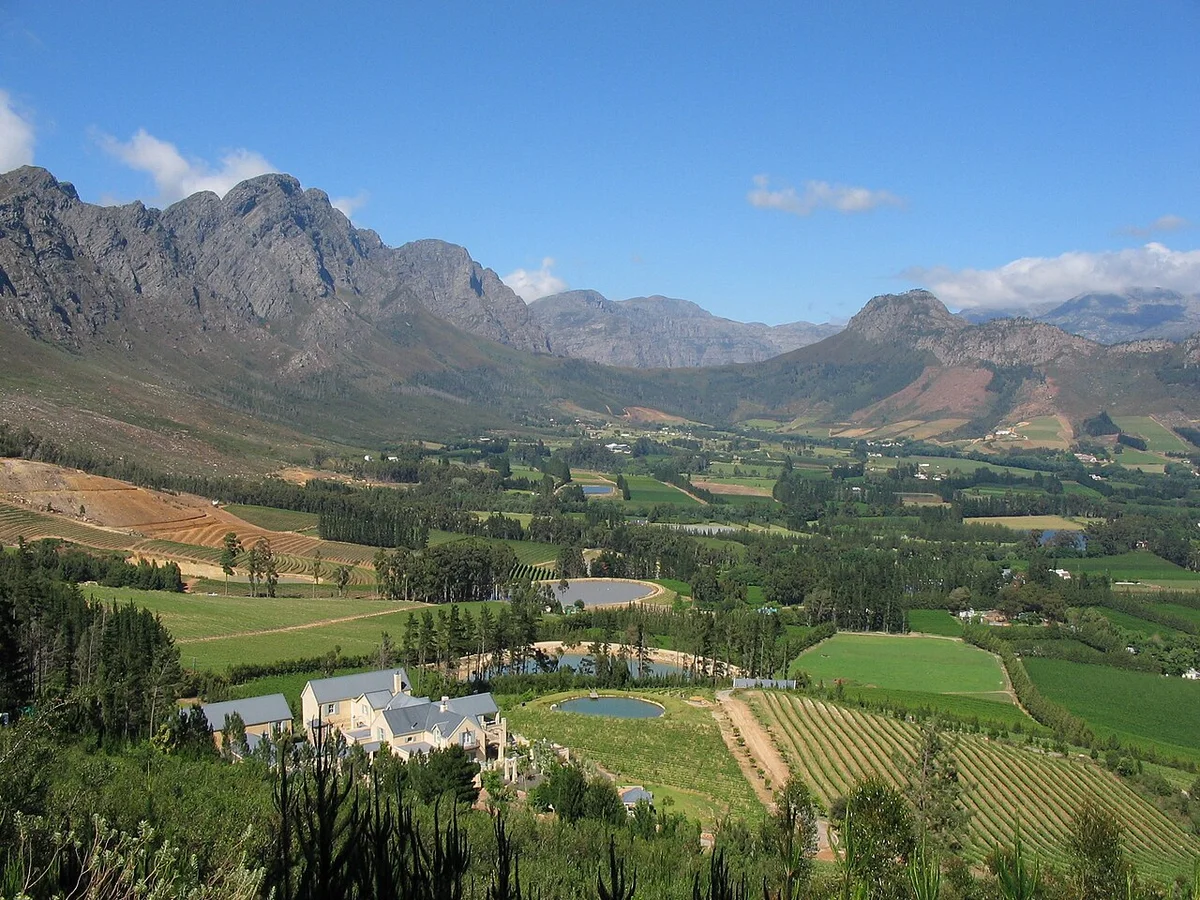
Quick answer: Franschhoek is a holding-cost market rather than a yield market, and the two things that make it so are municipal and geographic. It sits in Stellenbosch Municipality with its own roll and tariff, and it is an hour from Cape Town with no rail link, which removes the commuting tenant entirely. What a buyer is choosing here is an annual cost of ownership against seasonal revenue and discretionary resale demand.
Which municipality sets the rates here?
Stellenbosch Municipality does, and Franschhoek buyers routinely assume otherwise because the village is closer to Paarl than to Stellenbosch town. Stellenbosch maintains its own general valuation roll, sets its own residential tariff, operates its own rebate structure and runs a pensioner rebate scheme with its own application window.
Three practical consequences follow, and each one costs money if missed. The rates account a buyer should ask for is a Stellenbosch account, not an estimate carried from a metro page. The objection window that matters is Stellenbosch’s, published on its own calendar rather than the City’s or Drakenstein’s. And the rebate a qualifying owner can claim requires an application to Stellenbosch, on a form that is not automatically renewed. The rates and taxes guide explains how the City calculates its charge, which is useful for comparison and wrong for Franschhoek; for the neighbouring district under different rules again, see the Paarl page.
What does the hour to Cape Town remove?
It removes the commuter, and the commuter is what turns a pretty town into a rental market. Franschhoek sits about 75 kilometres from Cape Town over Helshoogte or through Paarl, an hour or more each way, with no rail alternative.
| Market | Distance to Cape Town CBD | Rental demand base |
|---|---|---|
| Paarl | about 60 km, 45 to 60 minutes, N1 corridor | Year-round commuters and local economy |
| Franschhoek | about 75 km, an hour or more, no rail | Seasonal visitors, small local pool |
| Somerset West | inside the metro, N2 corridor | Metro employment and Helderberg economy |
Fifteen kilometres does not sound decisive, and it is, because it crosses the line where a daily journey stops being tolerable. Our reading of winelands lettings is that the Franschhoek long-let pool is small enough that a landlord should treat a vacancy as a question of months rather than weeks, and should price the property on what it costs to hold rather than on what it might earn.
What does it actually cost to hold a Franschhoek property?
Holding costs here run heavier than metro equivalents at the same value, and the reason is stock type rather than tariff. Franschhoek property is often freehold on a larger erf, so there is no body corporate levy spreading maintenance across a scheme and no reserve fund accumulating in the background.
- Municipal rates on a Stellenbosch valuation, payable whether the property is occupied or standing empty.
- Buildings insurance priced with fire exposure at the mountain and fynbos interface, which is a real underwriting factor in this valley.
- Garden, pool and grounds on erven that are large by metro standards, running continuously rather than seasonally.
- Security as a fixed monthly cost, and higher where a property is unoccupied for parts of the year.
- A private maintenance reserve that nobody else is accumulating, on buildings that are frequently old.
A worked example puts a figure on it. A R9 million Franschhoek house with a large garden and a pool carries municipal rates on a Stellenbosch valuation, buildings insurance loaded for fire exposure, grounds and pool service running perhaps R6,000 to R9,000 a month, monitored security at R1,200 to R2,500, and a maintenance reserve that on an older building should sit near 1% of value, or R90,000 a year. Before a single repair, the annual holding cost clears R250,000. Set that against a holiday-let calendar that produces genuine revenue for perhaps 14 to 18 weeks of the year, and the shape of the investment becomes clear: this is an asset bought to be owned rather than to be operated.
Insider tip: ask a seller for three years of actual municipal and insurance statements rather than an estimate, and ask specifically what the insurer required for fire cover. In this valley an insurer’s conditions, such as clearance distances or roof material, can turn into a capital expense the buyer inherits.
Does heritage protection change what you can do?
It can, and it attaches to the building rather than to the owner’s plans. The National Heritage Resources Act protects structures older than 60 years, and Franschhoek’s village core carries Cape Dutch and Victorian stock comfortably past that threshold.
The effect is not a prohibition but a permission requirement: alterations and demolition on protected structures need approval, which adds time to a renovation programme and occasionally rules out a change entirely. A buyer intending to modernise, extend or reconfigure should establish the position on the specific building before offering, because a renovation budget built on the assumption of free rein is a budget built on the wrong premise. The same threshold applies to older stock in the Paarl core and to parts of Cape Town’s older suburbs.
When does the valley actually fill?
Franschhoek’s demand arrives in defined windows rather than continuously, and a holiday-let model stands or falls on how many of them a property captures.
| Window | Driver | Character |
|---|---|---|
| Mid-December to mid-January | Domestic and international summer holidays | Highest rates, booked far ahead |
| February to April | Harvest, warm weather, long weekends | Strong shoulder at lower rates |
| Winter months | Quiet, apart from event weekends | Largely empty for unbranded stock |
| Event weekends year-round | Wine, food and cycling events | Short, sharp spikes |
Two implications matter for underwriting. Revenue concentration is even sharper than on the Atlantic Seaboard, because Franschhoek lacks the year-round business and conference demand that a city carries, so a property that misses the summer window has almost no way to recover it. And the winter trough is when holding costs continue at full rate, which is the arithmetic behind treating this as a holding-cost market rather than a yield one.
Who is the buyer, and what does that do to exit?
Franschhoek sells to discretion rather than to necessity, and that shapes both directions of the market. Lifestyle and second-home buyers, semigration households who chose this valley specifically, and foreign buyers drawn by the wine and restaurant economy make up most of the demand.
Almost nobody buys here for yield, which means the market responds to confidence rather than to interest rates. When discretionary buyers are active, a good Franschhoek property sells quickly and at strength; when they pause, the pool thins faster than it does in a market with a working rental floor underneath it. For an owner that argues for a long horizon and for buying quality within the village rather than value at its edges, because the discretionary buyer who returns first is the one looking for the best thing available. The Stellenbosch guide covers the district’s other main market, and the pillar investment guide covers what any South African purchase costs a foreign buyer.
A working wine farm is a different purchase from a village house, and the difference is legal rather than agricultural: subdivision needs ministerial consent, water is licensed rather than owned, and occupiers can hold statutory rights that survive the sale. Our farm and land guide sets out the sequence.
Sources: Stellenbosch Municipality rates policy and pensioner rebate scheme for the jurisdictional position; National Heritage Resources Act 25 of 1999 section 34 for the 60-year threshold. Distances and drive times are indicative and vary by route and traffic. Obtain the Stellenbosch rates account, the insurer’s fire-cover conditions and the heritage position on the specific building before offering. Current as at 27 August 2026.
Frequently Asked Questions
Stellenbosch Municipality, in the Cape Winelands District, not the City of Cape Town and not Drakenstein. Stellenbosch runs its own valuation roll, rates tariff, rebate structure and pensioner rebate scheme with its own application dates. A Franschhoek owner needs the Stellenbosch rates account and the Stellenbosch objection calendar, and no Cape Town figure applies to their property.
Not comfortably. The drive runs about 75 kilometres and an hour or more each way depending on the route over Helshoogte or through Paarl, and there is no rail alternative. That removes the commuting tenant who supports rental demand in Paarl, which is 15 kilometres closer and connected by the N1, and it is the single biggest structural difference between the two winelands markets.
As a holiday let more than a long let. The village economy is wine, restaurants and tourism, so short-stay demand is genuine and concentrated in summer and around events, while long-let demand comes from a small pool of local workers and remote professionals. An investor should model this as seasonal revenue against a fixed annual holding cost rather than as a yield play.
Higher than the yield suggests, which is why this is a holding-cost market. Stock is often freehold on larger erven, so there is no levy spreading maintenance across a scheme: rates on a Stellenbosch valuation, buildings insurance including fire exposure at the mountain interface, garden and pool service, security, and a private maintenance reserve all fall on the owner. On a large winelands property those lines compound quickly.
It can. The National Heritage Resources Act protects structures older than 60 years, and Franschhoek's village core carries Cape Dutch and Victorian stock well past that threshold. Alterations and demolition on protected structures require permission, which adds time and cost to a renovation and occasionally rules one out. Establish the position on the specific building before offering rather than after.
Lifestyle and second-home buyers, semigration households who have chosen the valley deliberately, and a share of foreign buyers drawn by the wine and restaurant economy. Almost nobody buys here for yield, which is why the market moves on discretionary confidence rather than on interest rates, and why exit can be slow when discretionary buyers pause.
Get a Cape Town property shortlist
Share your budget, target area (Atlantic Seaboard, City Bowl, Winelands), and goal. We reply within one business day with matched stock and next steps.