
Granger Bay Waterfront: V&A Expansion Investor Brief
Granger Bay Waterfront: V&A R24bn reclamation, 3.8ha mixed-use, Growthpoint and PIC, late 2027 approvals, Green Point spillover for investors.
By Cape Town Invest Editorial · Updated August 21, 2026 · 11 min read
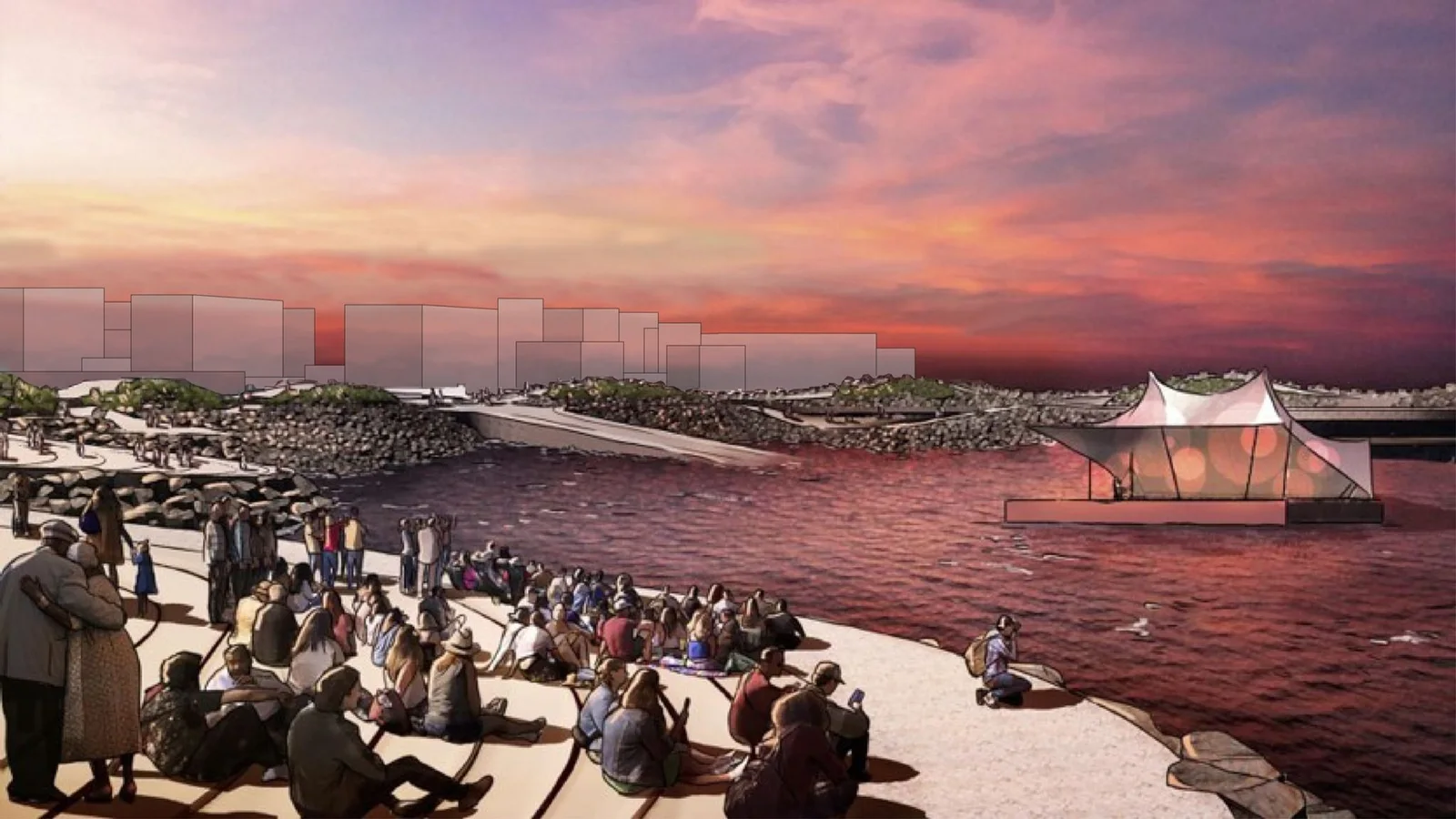
Quick answer: Granger Bay Waterfront is a proposed V&A expansion on roughly 3.8 reclaimed hectares budgeted near R24 billion, backed by Growthpoint Waterfront and PIC, with parliamentary approval expected around late 2027. It is a pipeline investor brief, not a buyable scheme today.
How should you underwrite Granger Bay?
Granger Bay sits between the clock-tower Waterfront and Green Point’s stadium corridor, the last major piece of harbour edge where the V&A can still grow without leaving the Atlantic Seaboard orbit. Growthpoint and PIC frame the project as shore protection plus economic development: breakwaters stabilise the coastline while reclaimed land hosts mixed-use towers, hotels, retail, and public promenades tied into existing pedestrian grids.
For property investors, Granger Bay is optionality, not inventory. Until marine reclamation clears Parliament and environmental law, there is no sectional title register to diligence. The actionable trade today is understanding how R24 billion of proposed amenity reshapes rents and liquidity in Green Point and completed Silo District stock, while refusing to capitalise unapproved land into current offers.
Our news analysis tracks approval milestones; this project brief translates those milestones into investor decision rules.
What numbers define Granger Bay proposal in 2026?
Four figures carry every Granger Bay headline, and each is sponsor modelling rather than a transacted market: a R24 billion budget, 3.8 reclaimed hectares, R8.8 billion of modelled GDP and 27,000 modelled jobs, with the first hard approval gate cited around late 2027. Read them as scale and political weight, not as return.
| Metric | Cited figure | What it tells an investor |
|---|---|---|
| Development budget | ~R24 billion | Institutional scale spread across a multi-year build |
| Reclaimed footprint | ~3.8 hectares, about 38,000 sqm | Small beside the existing V&A, enough for thousands of doors |
| Modelled GDP impact | ~R8.8 billion | The sponsors’ economic case, not a return on your unit |
| Modelled job creation | ~27,000 | The approval argument, weighted toward construction phases |
| First hard approval gate | Around late 2027 | Nothing before this date is a secured asset |
The number missing from that list is the one that would matter most to a buyer: a price per square metre on an approved, registrable unit. It does not exist yet and cannot until parliamentary and environmental authorisation clears and a sectional title register opens, which realistically sits 12 to 24 months after approval, with residential phases typically trailing hospitality by 24 to 36 months. Full build-out belongs on a 5 to 10 year horizon.
The practical consequence is that any 2026 conversation about Granger Bay pricing is really a conversation about Green Point and Silo District comparables. Underwrite those on their current rents and levies, then treat the R24 billion as a scenario input: amenity uplift on one side, competing supply on the other.
Approval pathway and why timing matters
Marine reclamation at Granger Bay crosses parliamentary approval, environmental impact assessment and coastal management scrutiny, with the first hard gate cited around late 2027. Three clocks run separately, and a sectional title register realistically opens 12 to 24 months after approval. Marketing that blends the three clocks into one date is a red flag.
- Policy approval: parliamentary and environmental authorisation
- Financial close: sponsors committing capital and appointing contractors
- First occupational certificates: years later, and the only date that carries rent
Public participation periods can shift schedules even when sponsors remain committed.
Until approval, treat Granger Bay like infrastructure equity: you monitor milestones, you do not underwrite rent on imaginary towers.
Spillover map for nearby owners
Spillover from a R24 billion precinct is two-directional for nearby owners. Green Point apartments gain walkable hospitality and retail depth while facing new competing residential and hotel keys. Silo District gains brand reinforcement and meets more ultra-premium supply. Sea Point long-lets gain corporate demand and carry the construction noise.
| Nearby node | Potential upside | Potential pressure |
|---|---|---|
| Green Point apartments | Walkable hospitality and retail depth | New competing residential and hotel keys |
| Silo District | Precinct brand reinforcement | Additional ultra-premium supply at margin |
| Sea Point long-let | Corporate and tourism demand | Traffic and construction noise during build |
| Century City income stock | Limited direct link | Still better base yield for income buyers |
If you own Green Point sectional title, rerun net yield after adding one conservative scenario with extra supply and one with amenity uplift, only the spread between those scenarios should influence your hold/sell decision.
What are the pros, cons and should track Granger Bay?
Granger Bay is optionality rather than inventory, and the balance sheet of arguments reflects that. The upside is institutional sponsorship and a R24 billion public realm on the harbour edge. The downside is that nothing is registrable before approval around late 2027, with sectional title registers opening 12 to 24 months after that.
- Institutional sponsors with decades of Waterfront delivery.
- Strengthens Cape Town’s global harbour brand.
- Potential first-mover informational edge for adjacent owners.
- Public realm and breakwater narrative supports long-term precinct quality.
Cons
- Not investable real estate until approvals and registers exist.
- Approval and litigation risk can delay or shrink scope.
- Future supply may compress yields nearby before you benefit from amenity.
- Pre-sales on unapproved land are hazardous for foreign buyers far from site.
The adjacent owner monitors milestones to stress-test hold assumptions.
The trophy buyer waiting for Waterfront stock compares completed Silo resales now versus pipeline wait risk.
The income investor should ignore Granger Bay for yield and buy Century City instead.
The foreign speculator must avoid non-refundable reservations without environmental and parliamentary sign-off.
Timeline milestones investors should log
| Phase | Indicative timing | Investor action |
|---|---|---|
| Public participation | Rolling | Read EIA summaries, do not pay deposits |
| Parliamentary marine approval | Around late 2027 cited | Treat as first hard gate |
| Financial close and contractors | Post-approval | Compare launched pricing to Silo resales |
| First occupational certificates | Years after approval | Underwrite yield on real levies only |
| Full precinct build-out | Multi-year (5-10 year horizon) | Monitor supply impact on Green Point |
Sponsors have discussed breakwater lengths measured in hundreds of metres to protect reclaimed land, marine works of that scale typically run multi-year construction windows after approval, with phase-one residential often lagging hospitality by 24 to 36 months.
Growthpoint’s listed REIT reporting gives foreign investors a transparency edge: watch annual presentations for capex timing, dividend cover, and Waterfront debt covenants that can shift phasing. Pair REIT disclosures with City of Cape Town planning portals rather than Instagram renders alone.
Granger Bay numbers foreign buyers should cite carefully
Sponsor numbers are scale indicators rather than returns. The R24 billion budget, the R8.8 billion GDP figure and the 27,000 job estimate all come from economic modelling attached to the reclamation proposal, and the 3.8 hectare footprint is roughly 38,000 sqm of developable land once reclamation completes.
- R24 billion budget: institutional scale across a multi-year build
- R8.8 billion GDP and 27,000 jobs: the approval argument, not your return
- 38,000 sqm reclaimed: enough for thousands of keys and doors over a decade
That footprint is a fraction of the existing V&A but large enough to add thousands of hotel keys and residential doors over a decade-long build-out. Use sponsor numbers in scenario conversations with advisers; do not capitalise them into a 10-year DCF on Green Point stock you already own.
How to track Granger Bay without overpaying today
Set calendar reminders for parliamentary committee dates, environmental appeal windows, and Growthpoint annual results presentations each March and September. When approval lands, expect a 12 to 24 month gap before credible primary residential pricing appears with NHBRC enrolment and sectional title registers you can audit. Until then, the highest-conviction Waterfront buys remain completed Silo resales with observable levies, or Green Point apartments with stadium and promenade walkability at lower ticket sizes than Silo penthouses.
Foreign buyers monitoring from London, Amsterdam, or Dubai should pair this brief with the Atlantic Seaboard investment guide so Granger Bay headlines do not pull you into unapproved deposits while better-documented stock is available elsewhere in Cape Town.
Scenario workbook for nearby Green Point owners
Scenario workbook for a Green Point owner is two runs of the same net yield model: one adding competing supply from a R24 billion precinct, one adding amenity uplift from it. Only the spread between the two runs should move a hold or sell decision, and neither belongs in a 10-year DCF as the base case.
- Supply run: extra residential and hotel keys, rent flat to lower
- Amenity run: deeper walkable retail and hospitality, rent firmer
- Base case: today’s rents and levies, unchanged until certificates exist
Document results in your investment memo so you do not rewrite history when marketing brochures arrive with rendered penthouses unattached to approved erf numbers.
Pipeline tracking is not passive: assign one calendar owner to screenshot approval notices and store them beside your purchase file for future capital gains calculations when you eventually sell nearby stock into a built-out Granger Bay precinct.
What red flags should pause this Cape Town purchase?
Red flags on a pipeline scheme are mostly paperwork that does not exist yet. A sales mandate that cannot show parliamentary or environmental approval references, a yield projection on unbuilt units, and a deposit routed to a personal account rather than a conveyancer’s trust are the three that should stop a Granger Bay conversation before the R24 billion headline does any work.
- Sales mandates that cannot show parliamentary or environmental approval references.
- Yield projections on unbuilt units without completed comparables nearby.
- Deposits into personal accounts rather than conveyancer trust.
- Marketing that treats 2027 approval as guaranteed construction start.
- Failure to disclose marine construction timeline and noise impacts on existing tenants.
What to verify next
Read the Granger Bay news brief and the Growthpoint Waterfront developer guide. If you own nearby stock, refresh net yield using the rental yield guide. Foreign buyers: keep FICA and exchange-control records clean via the foreign buyer hub. When primary sales eventually open, apply the same NHBRC and off-plan checks as any new Cape Town development, but today, verification means watching approvals, not signing OTPs.
Frequently Asked Questions
Granger Bay is a proposed V&A Waterfront expansion east of the existing precinct, reclaiming roughly 3.8 hectares of marine territory with engineered breakwaters, mixed-use residential, hotel, retail, office, and public promenade space. Growthpoint Properties and the Public Investment Corporation back the joint venture. Public filings cite a development budget near R24 billion and economic modelling of about R8.8 billion GDP impact and 27,000 jobs.
Not on reclaimed land, parliamentary and environmental approvals for marine works are expected around late 2027. Any marketing before final authorisation is indicative only. Investors can buy existing nearby stock in Green Point or Silo District while tracking pipeline milestones, but should not treat pre-approval reservations as secured assets.
A R24 billion amenity extension between the V&A Waterfront and Green Point could deepen hospitality demand, walkable retail, and long-stay rental appeal. It may also add competing hotel and residential supply. Underwrite nearby holdings on current rents and levies, treating Granger Bay uplift as optional scenario analysis, not base-case yield.
Approval delay, environmental litigation, marine construction cost inflation, and precinct supply shocks are the main risks. Foreign buyers face the same ownership rules as locals but must avoid non-refundable deposits on unapproved phases and record offshore capital cleanly for future repatriation.
Track Waterfront communications, parliamentary marine reclamation processes, and our news brief on the Granger Bay proposal. Confirm any sales mandate against approved zoning and environmental authorisations before paying reservation fees.
Get a Cape Town property shortlist
Share your budget, target area (Atlantic Seaboard, City Bowl, Winelands), and goal. We reply within one business day with matched stock and next steps.