
Amdec Harbour Arch: Living Inside a Building Site
Tower 1 is finished and the precinct is not. What an owner holds while the cranes are still there, and the parking question that decides a resale.
By Cape Town Invest Editorial · Updated September 3, 2026 · 11 min read
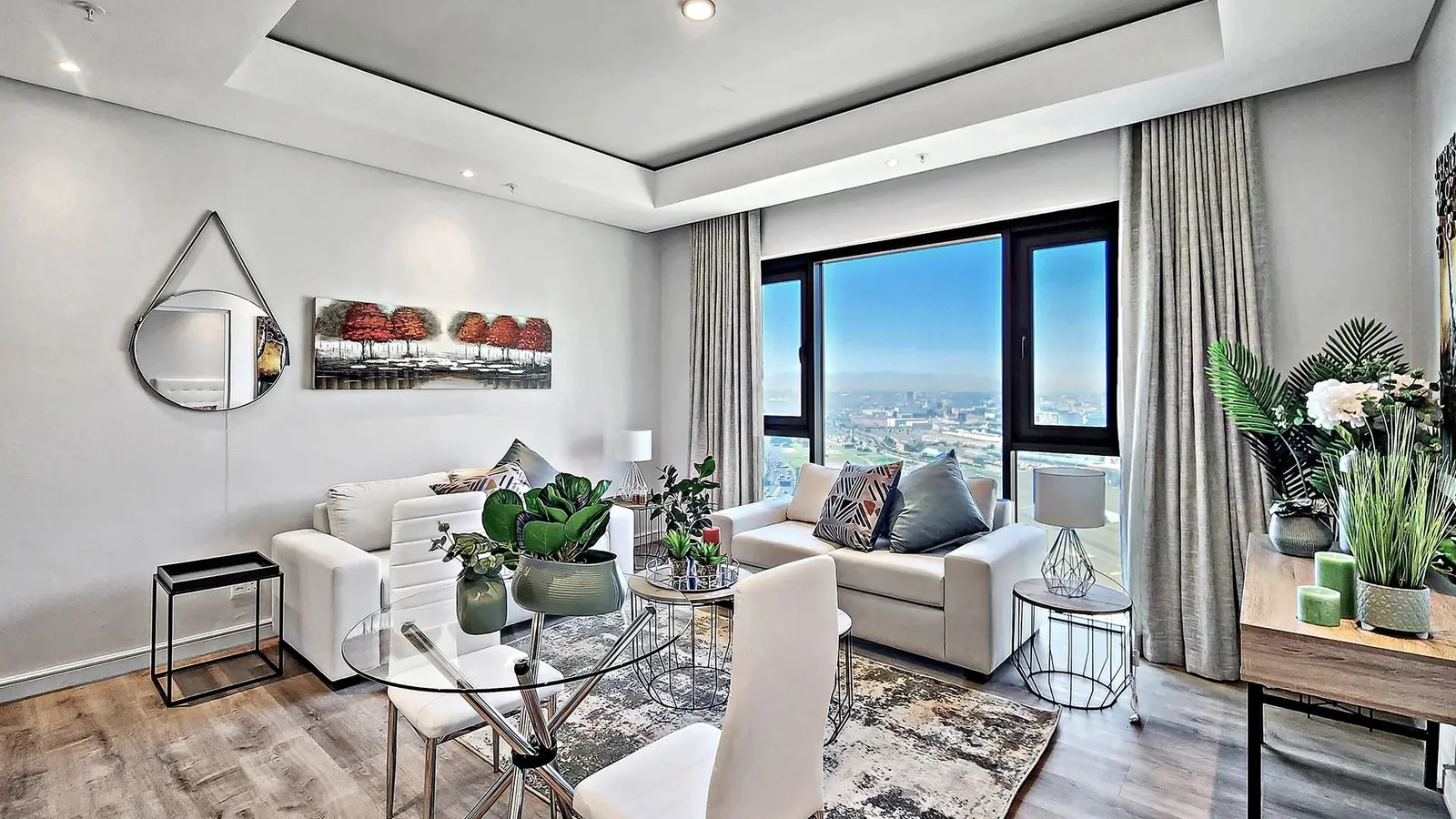
Quick answer: Harbour Arch is a phased precinct on the Foreshore, and Tower 1 handed over from May 2023 with roughly 560 apartments while the towers behind it are still to come. That means an early owner buys a finished apartment inside an unfinished place: the bond and the levy start immediately, the disruption starts immediately, and the amenity that justifies the price arrives years later. The second thing worth knowing before an offer is how your parking bay is held, because that single answer moves a resale.
What does an early owner actually hold?
A completed apartment in an incomplete precinct, and the two do not arrive together.
Tower 1 was handed over from May 2023, roughly 560 apartments and about 1,200 parking bays across some 80,000 square metres, at launch prices around R2 million. It was delivered on programme, which is a real point in the developer’s favour given when it was built. What it was delivered into is a precinct still being constructed around it.
That produces an asymmetry an off-plan brochure never shows. Your bond, your levy and your rates begin on transfer. The precinct’s completed public realm, its retail, its finished streetscape, the things that justify the pricing, arrive when the later phases do. In between, you own a finished flat with a view of the works.
This is not a criticism of phased development, which is how large precincts get built anywhere. It is a description of what the first buyers are financing, and it should be in the model rather than in the disappointment.
How much does the construction actually cost you?
In rent, and for longer than most buyers assume.
Noise, dust, altered access, crane movements and contractor traffic all bear on what a tenant will pay and on how fast a vacancy refills. Unlike a seasonal effect, this one runs for the duration of the build. A tenant with options will discount it, and a tenant without options will leave when they get some.
The discipline is straightforward: underwrite the early years at a rent below what the finished precinct will support, and treat the uplift as something to be earned when the works end rather than as part of your entry case. A model that applies completed-precinct rents to a construction-period holding is not optimistic, it is simply measuring the wrong years.
| Tower 1 today | The finished precinct | |
|---|---|---|
| Building | Complete, with a levy history to read | Not yet built |
| Surroundings | Active construction | Completed public realm and retail |
| Achievable rent | Discounted by the works | What the pricing assumes |
| Levy | About R3,800 to R5,200 a month | To be set by later schemes |
| What you can verify | Financials, minutes, the actual unit | A plan |
The parking question that decides a resale
This is the specific, checkable thing that separates a good Harbour Arch purchase from a bad one, and it is almost never asked before the offer.
A parking bay in a sectional title scheme can be held in three ways, and they are not equivalent:
- A separate section on the title deed. You own it. It transfers with the apartment and can be sold or let separately.
- An exclusive use area registered against the scheme. You have a registered right to use it. It transfers with the apartment.
- A monthly hire arrangement with the body corporate. You have a licence. The trustees can reprice it, reallocate it or end it, and it does not transfer with the apartment.
Only the first two survive a resale intact. A seller who has parked in the same bay for six years under an arrangement of the third kind does not have a bay to sell, and a buyer who assumed otherwise finds out during conveyancing at the worst possible time.
Tower 1 carries roughly 1,200 bays against about 560 apartments, which sounds generous and settles nothing. The ratio tells you bays exist. It does not tell you how yours is held, or whether your unit’s base price included one. Get the legal form of your specific bay confirmed in writing before you offer, and read it against the sectional title register rather than the sales sheet.
What is the real carry?
Heavier than the launch price implies, which is the usual Foreshore story.
Body corporate levies on Tower 1 stock run about R3,800 to R5,200 a month, and parking hire adds roughly R950 a month on some arrangements. Municipal rates sit outside the levy entirely and are billed to the owner at about 0.0064 in the rand for 2026/27, after a R620,000 rates-free slice on homes valued at R8 million or less. On a unit bought near R2 million that combination is what converts a respectable gross into a modest net, and it is why the levy statement matters more here than the asking price does. The full entry cost around it, from duty to conveyancing, is in the cost of buying guide.
What a levy has to fund, and what a scheme can and cannot recover, is set out in the levies guide. The specific building is covered on the Harbour Arch page.
Tower 1 or a later tower?
Each solves the other’s problem and creates its own.
Tower 1 is a completed building. It has a real levy, real financials, real minutes and a real body corporate, all of which you can read before committing. It also inherits the cranes of everything built after it, for as long as that takes.
A later tower is an off-plan purchase. It will spend less of its life inside a building site, and in exchange it carries delivery risk, a levy set from the developer’s own budget rather than from experience, and no financials at all to inspect. The general version of that trade is worked through in the off-plan versus resale comparison.
The pros and cons of the precinct as a whole:
- In your favour: a developer with a national record and a Tower 1 delivered on programme, Foreshore location, and entry prices below the Atlantic Seaboard.
- Against you: years of construction discounting your rent, a heavy levy and parking carry, and a parking title question that can quietly remove value at resale.
- Worth weighing separately: whether you are buying the precinct as it will be, or the apartment as it is. Only one of those is available to inspect.
For a Cape Town counterparty whose financial position is actually published rather than inferred, the Growthpoint page covers the one development on this site where that is possible.
What to establish before you offer
| Question | Get it in writing from | Why it cannot wait |
|---|---|---|
| How your specific bay is held | The conveyancer, against the register | Only two of the three forms survive a resale |
| Whether a bay is in the base price | The seller or developer | Buyers routinely assume one is |
| The current levy and its three-year trend | The managing agent | It is the largest number in your net |
| The remaining build programme | The developer | It is the length of your rent discount |
| Achievable rent now, not at completion | Two or three live listings | The model has to match the years you own |
The one most often skipped is the last. A rent quoted for the finished precinct is a forecast about a place that does not exist yet; a rent quoted by a letting agent for a unit in Tower 1 this month is a fact about the place you are buying into.
Sources: Sectional Titles Schemes Management Act 8 of 2011 for the section, exclusive use area and body corporate regime that governs how a parking bay is held; City of Cape Town budget 2026/27 adopted 29 June 2026 for the rates figures. Tower 1’s handover from May 2023, unit and bay counts and floor area are the publicly stated scheme figures; levy and parking hire bands are observed ranges on Tower 1 stock rather than a quoted tariff, and both should be confirmed for the specific unit. Current as at 27 August 2026.
Frequently Asked Questions
You take occupation before the precinct exists. Tower 1 handed over from May 2023 with roughly 560 apartments, and the towers behind it are still to come, so an early owner lets and lives inside an active construction site for years. The amenity that justifies the price arrives later than the bond does, and the disruption arrives first.
It is a discount you should model rather than discover. Noise, dust, altered access and crane activity all bear on what a tenant will pay and how quickly a vacancy fills, and they run for the duration of the build rather than for a season. Underwrite the early years at a rent below what the finished precinct will support, and treat the uplift as something to be earned rather than assumed.
Because a bay can be held three different ways and only two survive a sale intact. A bay registered as a separate section on the title deed, or as an exclusive use area registered against the scheme, transfers with the apartment. A bay held as monthly hire does not: it is an arrangement the trustees can reprice or withdraw, and a buyer who thinks they own it discovers otherwise at resale.
Only that bays exist, not that yours is yours. Tower 1 carries roughly 1,200 bays against about 560 apartments, which sounds generous, and the ratio says nothing about how any individual bay is held or whether your unit's base price included one. Establish the legal form of your specific bay in writing before the offer.
Heavier than the launch price suggests. Body corporate levies run about R3,800 to R5,200 a month on Tower 1 stock, and parking hire adds roughly R950 a month on some arrangements, before municipal rates at about 0.0064 in the rand. On a unit bought near R2 million that combination is what pulls a respectable gross into a modest net.
It swaps one problem for another. A later tower is bought off-plan, so it carries delivery risk, an unproven levy and no financials to read, but it will spend less of its life inside a building site. Tower 1 is a completed building with a real levy history and a real body corporate, and it inherits the cranes of everything built after it.
Get a Cape Town property shortlist
Share your budget, target area (Atlantic Seaboard, City Bowl, Winelands), and goal. We reply within one business day with matched stock and next steps.